
A cheaper DeFi transaction is not necessarily a better transaction. In practice, the most expensive mistake is often not paying a high gas fee; it is signing a transaction whose outcome was misunderstood, then paying again to repair the damage. That counterintuitive distinction matters for anyone considering a Rabby extension download in the United States, where users may move between Ethereum and several EVM-compatible networks in a single afternoon.
Consider a realistic case. An Ethereum user sees a favorable swap, notices that network fees are elevated, and tries to save money by rushing through the wallet approval. The transaction fails, the fee is still charged, and the user then approves a second transaction without noticing that the token allowance is broader than necessary. Gas optimization helped with neither cost nor safety. The better mental model is that a wallet is a decision interface: it should help the user understand what a transaction is attempting before the user decides how much speed, certainty, and exposure to accept.
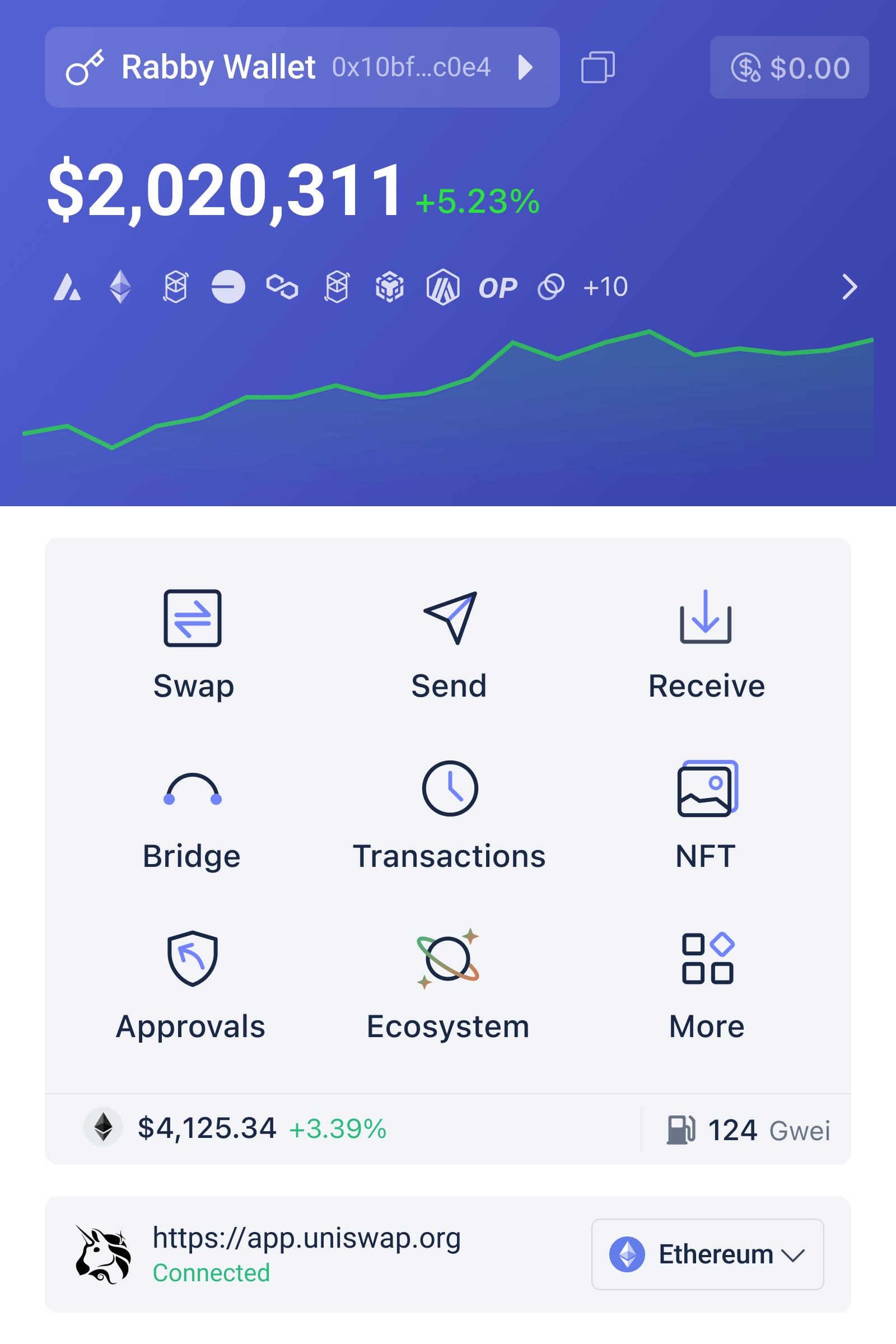
Why gas optimization is more than finding the lowest fee
On Ethereum and other EVM networks, “gas” measures the computational work required by a transaction. A simple transfer generally needs less computation than a decentralized-exchange swap, a liquidity-position update, or a multi-step lending action. The final cost depends on both the amount of gas used and the network’s current price for that gas. Under Ethereum’s fee market, the base fee changes with demand, while an additional priority fee can influence how quickly validators include a transaction.
This creates a common misconception: users treat the displayed fee as if it were a fixed price. It is better understood as an estimate under changing conditions. A wallet can improve the estimate, but it cannot control congestion, contract behavior, validator incentives, or whether a protocol’s state changes before the transaction is mined. If a swap uses more computation than expected, or if the market moves while the transaction waits, the economic result can be worse even when the nominal gas estimate looked acceptable.
There are several practical ways to reduce avoidable costs. Choosing a less congested EVM network may lower the fee, but the decision is only sensible if the desired liquidity, token authenticity, bridge route, and protocol security are also acceptable. Batching actions can reduce duplicated overhead when a protocol supports it, although a more complicated call may be harder to inspect. Waiting for congestion to ease can help, but it introduces price risk. Increasing the priority fee may improve inclusion speed, yet it does not guarantee a favorable swap price or a successful contract call.
The useful question is therefore not “What is the cheapest setting?” It is “What is the lowest total risk-adjusted cost?” That total includes the visible network fee, the chance of failure, slippage, the cost of delayed execution, and the potential loss from interacting with a malicious or defective contract. A transaction that costs a few dollars more but is clearly understood may be cheaper than a low-fee transaction that fails or creates unnecessary approval exposure.
The security layer: what should happen before signing
DeFi security begins before a transaction reaches the blockchain. Once a transaction is confirmed and mined, the network generally cannot reverse it because the user changed their mind. Wallet review is therefore a form of preventive control, not a guarantee. A security-conscious interface should help translate technical fields into questions a human can answer: Which account is paying? Which network is active? What contract is being called? Which assets may leave the wallet? Is the user granting a one-time allowance or a potentially broad permission?
This is particularly important with token approvals. A swap often requires a token contract to spend a specified amount on behalf of the user. An unlimited approval can be convenient because it avoids repeated approval transactions, but it also increases the consequences if the approved contract is later compromised or the user interacted with the wrong address. A limited approval may require another transaction and another gas payment, yet it can reduce standing exposure. Neither choice is universally correct; the trade-off is convenience and cost against permission scope.
Transaction simulation can add another layer of understanding by estimating the state changes a call would produce. For example, a simulation may help reveal that a swap is expected to send one asset and receive another, or that an action will change a lending position. But simulation has a boundary that users should remember: it is a forecast based on available state, not a crystal ball. A block may be mined later, prices may move, a contract may behave differently under changed conditions, or an approval may create risks that are not obvious from the immediate balance change.
That is why a warning should be treated as a prompt for investigation rather than an automatic verdict. False positives can occur, especially in a fast-changing ecosystem with new contracts and unfamiliar tokens. Conversely, the absence of a warning does not prove that a protocol is safe. Code audits, reputation, liquidity, governance, and operational controls are separate questions. A wallet can improve the user’s visibility into a transaction; it cannot replace due diligence on the application itself.
For users installing a browser wallet, the installation path is part of the security model. If you are researching a rabby extension download, treat the page as an entry point rather than proof of authenticity. Check that the browser extension comes from the expected publisher and official distribution channel, compare the extension name and permissions, and avoid installing software from advertisements, unsolicited messages, or lookalike domains. Never type a recovery phrase into a website or share it with “support.” A legitimate wallet setup does not require another person to know it.
What Rabby’s current positioning means for users
Rabby’s recent project messaging presents the wallet as a tool for Ethereum and EVM networks, with Chrome and Brave among the stated ways to get started. That cross-chain emphasis reflects how DeFi has evolved. The early wallet experience was largely about holding ether and sending tokens. Today, a user may connect to an exchange, a lending market, a staking interface, a bridge, and a governance application across several networks. The difficult problem is no longer merely key storage. It is maintaining an accurate mental model while the wallet moves between contracts, chains, permissions, and changing balances.
A multi-chain interface can reduce one class of error: using the wrong network for the intended application. It may also make transaction context easier to review before signing. Yet convenience can create a new boundary condition. The more networks and applications an interface supports, the more important it becomes to verify chain identifiers, token addresses, bridge destinations, and the origin of every connection request. A smooth user experience should reduce friction around good decisions, not eliminate the moments when a user needs to stop and inspect details.
For an American DeFi user, recordkeeping adds another practical dimension. Swaps, liquidity actions, bridging, and rewards can have different accounting implications, and wallet history alone may not explain the economic substance of every action. Gas fees also affect the net result of a strategy. A lower fee on a transaction is useful, but the user still needs to retain records of what was exchanged, on which network, and under what protocol conditions. Tax treatment is fact-specific and can change; a wallet is not a substitute for professional advice or organized transaction records.
A reusable decision framework before you confirm
Before signing, separate the decision into four checks. First, verify identity: the wallet account, network, application domain, contract, and token addresses. Second, verify effect: what leaves the account, what should arrive, what approval is being granted, and whether the displayed result matches the intended action. Third, verify economics: estimated gas, slippage, timing sensitivity, and the cost of failure. Fourth, verify reversibility: which parts can be undone, and which permissions or transfers become permanent once mined.
This framework is more durable than memorizing a particular fee setting. It works during quiet periods and during a sudden US market selloff. It also exposes an important distinction between transaction failure and economic failure. A reverted transaction may not change the intended token balances, but it still consumes gas. A successful transaction can be more serious if it sends assets to the wrong address or grants a dangerous permission. “Success” in the blockchain explorer is not the same as “good outcome” for the user.
Users can also improve efficiency by grouping related actions when the application supports safe batching, avoiding unnecessary approval resets, and choosing execution times when urgency is low. However, optimization should not become an excuse to accept opaque transactions. If a complex call cannot be explained in plain language, the appropriate response is to investigate further, reduce the amount at risk, or postpone the action. Small test transactions can limit the cost of an address or workflow error, though they do not prove that a contract is trustworthy.
What to watch next
The next stage of wallet design is likely to be judged less by the number of supported chains than by the quality of transaction comprehension. If interfaces can reliably show expected state changes, permission scope, network context, and meaningful uncertainty, users may make fewer costly mistakes without needing to become smart-contract engineers. The condition is important: better presentation helps only when the underlying data is current and users understand that estimates remain conditional.
Watch for clearer permission management, more informative simulations, improved chain and contract identification, and safer recovery practices. Also watch what does not change. Private-key responsibility, phishing, compromised applications, bridge risk, market volatility, and irreversible settlement remain structural limitations. No extension can remove them. The strongest wallet workflow is therefore not “install and trust”; it is install carefully, inspect deliberately, optimize the full cost of execution, and keep the amount at risk proportionate to what you understand.
Frequently asked questions
Does a lower gas estimate mean a transaction is safer?
No. Gas estimation concerns expected computational cost and fee conditions. It does not establish that a contract is legitimate, that a token is authentic, that slippage is acceptable, or that an approval is narrowly scoped. Safety and cost should be reviewed separately, then considered together.
Should I always use a limited token approval?
Limited approvals generally reduce the amount a contract can spend, which can reduce exposure. They may also require more transactions and additional gas. The sensible choice depends on the application, the value involved, how often you use it, and whether you are comfortable managing permissions over time.
Can a wallet simulation guarantee that my DeFi transaction will succeed?
No. Simulation is useful evidence, but it reflects a particular view of blockchain state. Market movement, competing transactions, changed liquidity, contract conditions, or network timing can alter the result. Use simulation to improve understanding, not to replace final checks and sensible position sizing.
